Showing posts with label Council Recap - Wan. Show all posts

Friday, August 7, 2026

Jeff Wan Not Seeking A Third Term

City Council Correspondence: The excerpts below have been sourced from the website of council member Jeff Wan to share with the Clayton Watch Community. You can access council member Wan's website by following this link: https://www.jeffwanforclaytoncitycouncil.net. While we may not always agree with the opinions shared, we believe in facilitating a platform for respectful debates. Thank you for contributing to the ongoing conversation in the comments section. Remember to keep your comments respectful and concise.

--------------------------------------------------------------------------
Two Terms, and Looking Ahead
Jeff Wan, Mayor
--------------------------------------------------------------------------
When I first ran for City Council, part of my motivation was simple: I wanted to move beyond complaining about things I thought should be different and start doing the work to make them better. I also wanted to show my kids that if you care about your community, you have to be willing to participate in the process. If you think there is a better way, then learn the process, do the work, and try to be the change you want to see. 

I also believed I represented a voice that was not fully present on the Council at the time. Even for issues where there was widespread community disagreement, the Council was always unanimous. A City Council should reflect the community it serves. That does not mean every Councilmember will share every resident’s experience, but it does mean the Council benefits when different viewpoints and different community priorities are represented. 

During my time on the Clayton City Council, my work has focused on fiscal discipline, transparency, public safety, infrastructure, quality of life, responsible revenue planning, and addressing long-standing issues that had gone unresolved for years. The common theme across this work is diligence. City government should listen to residents, understand the facts, use public money carefully, maintain the assets we already own, and make difficult decisions only after doing the work required to support them. 

I want to highlight a few areas where the City made significant progress over my last two terms: 

Transparency and Communication 

For government to work for the people, residents need to be informed. At the same time, people should not have to follow every detail of City operations to understand what their elected representatives are doing. That is why I began writing updates before and after every City Council meeting. The purpose of these updates is simple: make it easier for residents to know what is happening, what decisions are coming, and how they can participate when an item matters to them. 

From routine administrative items to major policy decisions, the City always has work underway, and residents should be able to understand it without having to search through lengthy agendas or watch hours of meeting video. This became especially important because the City uses “action style minutes,” which capture the decisions made but not the discussion, reasoning, or rationale behind those decisions. I believe elected officials have a responsibility to explain their reasoning. I have worked to make that information easier to access and easier to understand. 

Fiscal Discipline and Financial Sustainability 

Fiscal discipline has been one of my highest priorities on the Council. I served on the Budget/Audit Committee throughout all of my years in office. During this time, I pushed for a more disciplined and conservative approach to the City’s finances. 

I recommended that the City save surpluses to help stabilize future pension expenses. I identified and helped correct numerous issues in the City’s external audit reports. I helped facilitate funding for an additional school crossing guard. I was also one of the first to identify the structural financial challenges the City is now facing. 

When the City revisited its expenditure policy, I pushed for a more fiscally conservative version. Even when I was in the minority, I consistently argued against using consultants for routine activities when the City could reasonably do the work itself. I also opposed spending tens of thousands of dollars and significant staff time on a survey where the results were largely predictable. 

Later, when inflation began rising and the cost of goods and services started outpacing the City’s revenue growth, there were immediate calls to raise taxes. I resisted that approach. My position was that the City first needed to understand its true financial condition before taking any action to raise revenue. Taxes should be a last resort, after the City has done the work to understand its costs, evaluate its revenues, improve operations, and identify other options. 

The City conducted a much deeper review of its actual costs, revenues, service levels, and long-term financial needs. We looked at where revenues were falling short, where costs were rising, and what options were available before turning to any tax measure. A significant part of that effort was updating the City’s master fee schedule. Historically, fees had not always kept pace with the actual cost of providing services. That meant the City was not always recovering the right amount for the services it provided. Through the fee study, we updated the fee schedule to better reflect actual costs and created a more sustainable process for keeping fees current going forward. 

We also updated the City’s investment policy and began more robust reviews of City investments. The City moved toward higher-yield investment products and managed investment services, allowing Clayton to rely on professional expertise rather than placing that responsibility solely on limited City staff. This helped improve returns on existing funds without raising taxes. 

The City also took a look at its organizational structure. With only 26 total employees, there are not many easy changes available. Even so, we made thoughtful adjustments. Some positions were eliminated, some were consolidated, and some functions were moved under different areas. Those changes allowed the City to save money, continue delivering core services, and, in some areas, provide new services focused on the City’s highest priorities. 

The theme has been consistent: spend carefully, protect reserves, understand the City’s true financial position, and make sure taxpayer dollars are used for clear public benefit. 

Responsible Revenue Planning 

After the City pursued cost savings, fee updates, investment improvements, organizational changes, and operational reviews, the City still remained in a deficit position. At that point, it became clear that leaving the deficit unresolved would be irresponsible. Once the City had taken every reasonable action to reduce costs and increase non-tax revenue, the remaining option was to consider new revenue. 

The Council spent significant time evaluating potential revenue sources. We held workshops, worked with staff, reviewed financial projections, and received input from residents. The conclusion was that the most appropriate course of action was to place a 1% local sales tax before Clayton voters this November. Clayton has never passed a local sales tax increase since incorporation. The current sales tax rate is 8.75%, but Clayton receives only a small portion of that existing amount. Most of it goes to the state, county, and other voter-approved measures. 

A 1% local sales tax is different because 100% of the local tax collected would stay with the City of Clayton. In fact, the estimated revenue from a new 1% local sales tax is roughly equal to what Clayton currently receives from the existing 8.75% sales tax rate. The projected revenue, approximately $800,000 to $1 million per year, would be significant for a City with roughly $7 million in annual General Fund spending. This work reflected the appropriate level of diligence: understand the City’s financial position, reduce costs where possible, increase non-tax revenues where possible, and only then ask voters to consider a tax measure. 

City Infrastructure 

The City began, continued, and made progress on several important infrastructure and facility improvements. 

The City was awarded a 1% below-market interest loan to fund the largest infrastructure investment in Clayton since the Oakhurst development was constructed. That project allowed the City to make major improvements across public facilities and infrastructure, including solar installation at City facilities, lighting replacement throughout the City, electric vehicle charging, water efficiency improvements, and HVAC efficiency upgrades. 

We also applied for and received FEMA funding to repair portions of Cardinet Trail that were damaged during major storms. That process took time and required significant administrative follow-through. I thought it was important to see the work through because, on a tight City budget, we should use outside funding whenever it is available and appropriate. There was an initial push to use reserves to move the work forward, but pursuing outside funding first was the more fiscally responsible approach. 

The City also began preliminary work on the library refresh project, which is scheduled to begin soon. Councilmember Trupiano has been a key leader in pushing this project forward. Maintenance of City-owned buildings has been deferred for many years. The library, which also serves as the City Council meeting space, has not received basic upkeep such as carpet replacement and painting. Maintaining the assets we already own is one of the most practical and responsible things the City can do. 

Together, these projects reflect a larger priority: reinvesting in the City’s existing infrastructure, improving safety and accessibility, using outside funding where possible, and taking better care of the public assets residents already own. 

School Safety and Pedestrian Improvements 

As a parent, I have always been especially focused on traffic safety around schools. 

When the president of the Mt. Diablo Elementary PFC reached out in 2019 to ask whether the City could help provide an additional crossing guard outside the school, I was glad to help. Initially, the City helped by accepting a donation from the PFC and coordinating with existing service providers. That cooperation was valuable, but I believed school safety should be a City priority, not just a parent-funded effort. 

As part of the Budget/Audit Committee, I worked to make sure that crossing guard was included in future budgets. I worked with the Principal of the middle school to add a diagonal pedestrian crossing outside the school. Improving traffic and pedestrian safety around schools is one of the ways the City can make sure its spending reflects its priorities. The sidewalk improvements near the elementary school build on that same priority: make it safer and easier for children and families to get to school. 

Housing Element Compliance 

The City also completed one of the most difficult and time-consuming state planning requirements facing California cities: securing approval of Clayton’s Housing Element from the California Department of Housing and Community Development. California law requires every city and county to adopt a Housing Element as part of its General Plan. The Housing Element is the City’s plan for how it will accommodate housing needs across income levels. It does not require the City itself to build housing, but it does require the City to plan for housing, identify sites where housing could be built, evaluate zoning and development constraints, create programs to support housing production, and show how the City can accommodate its assigned Regional Housing Needs Allocation. 

For Clayton, this was a years-long process. The City responded to HCD comments, revised policies and programs, analyzed available sites, evaluated constraints, and worked through a detailed state review process. The City made multiple updates to its Housing Element, including rezoning multiple sites that HCD failed to recognize. This required substantial staff time, consultant work, Planning Commission review, Council discussion, public engagement, and repeated coordination with HCD. The process was made more difficult because HCD continued to request additional revisions not required by statute even after the City had made updates intended to comply with statutory requirements. The entire process stalled when HCD stopped responding to the City. It was Councilmember Trupiano who led meetings with State Senator Grayson asking him to assist with getting responses from HCD. 

Geological Hazard Abatement District 

Another major area of focus was the Geological Hazard Abatement District (GHAD). 

When I first joined the Council, I reviewed the GHAD reports and saw that much more work needed to be done. As early as 2019, I requested that the GHAD’s detailed scope of work, timing, and funding needs be discussed. The GHAD is distinct from the City of Clayton, although the Clayton City Council serves as the GHAD Board. The GHAD assesses a levy on approximately 1,400 parcels in Clayton, with different tiers based on property type. The purpose of that assessment is to fund GHAD activities. 

The GHAD’s duties are outlined in the Plan of Control and include maintenance of drainage facilities, inspection of drainage ditches, debris removal, repairs, drain cleanout, erosion control evaluation, and monitoring of geological movement and water pressure through devices such as inclinometers and piezometers. The problem was that the GHAD’s revenues were far below what would be required to perform those duties. The assessment level was set before Proposition 218, and after Proposition 218, increasing the assessment required voter approval. Prior assessment revenue was approximately $47,000 per year, with most of that amount consumed by program administration rather than actual monitoring, maintenance, or mitigation work. 

Over time, many of the monitoring devices used to measure geological movement were damaged or no longer operable. In several areas where movement is possible, the GHAD did not have adequate information to determine whether movement was occurring or how severe it might be. If significant geological movement occurs, it can pose serious risk to nearby homes. I recognized that this was a long-standing problem. Working with Councilmember Trupiano, we helped push for staff to analyze the GHAD’s actual needs and the funding required to perform its responsibilities. The basic question was simple: why have a Geological Hazard Abatement District if it does not have the funding to do the work it was created to do? 

We took that question to the affected residents and asked whether they would support increasing GHAD assessments so the district could perform its duties. The measure passed. As a result, a district that had been underfunded for decades is now better positioned to do the work it was created to do: monitor risk, maintain facilities, and address hazards. 

Regency Gate Quality of Life 

One of the most significant neighborhood quality-of-life issues during my first term involved the area outside Regency Gate. After the trailhead became popularized through social media and organized hiking groups, a quiet neighborhood experienced a major increase in traffic, parking demand, blocked driveways, trash, speeding, and aggressive driving from people looking for parking. Residents had raised concerns before, but the issue had not gained enough traction at the City. 

I spent substantial time talking with affected residents, as well as people who wanted to preserve public trail access. The goal was to find a balanced solution that protected neighborhood quality of life while still allowing the public to access the trails. I proposed a permit parking system. Although there was initial hesitation, the majority of the Council was ultimately persuaded, and the City implemented the program. The result has been successful. Residents have described the change as night and day. 

Summer Concerts and Community Partnerships 

We also made the Summer Concerts in the Grove more sustainable. For years, the concert series relied heavily on current and former Councilmembers and an informal network of volunteers and relationships. That approach helped keep the tradition alive, but it was not a sustainable long-term structure. Lead by Councilmember Trupiano, we brought in an outside firm to help manage the series more formally, so the work does not sit with individual Councilmembers when that is not really the role of the Council. 

That change allows Councilmembers to participate in and enjoy the events alongside residents, while also creating a more reliable operating model for the future. We also improved the funding and community benefit model for the concerts. The City continues to seek sponsorships and donations, and those efforts have been successful in helping cover the cost of the series largely due to the work of Councilmember Trupiano who in her time on Council has doubled the amount of sponsorships received. In addition, I proposed partnering with local schools to help collect donations during the concerts. In return, the donations are shared with the schools. As a result, the concert series not only brings the community together, but also creates a way for residents to support local schools. It turns a City event into a broader community partnership. 

Updating Local Ordinances 

I worked to update local ordinances that were outdated, overly restrictive, or inconsistent with how residents actually live. Before being elected, I was surprised by how restrictive Clayton’s sign ordinances were. After reviewing the rules adopted by prior Councils, it became clear that the City’s ordinances were overly restrictive and likely inconsistent with First Amendment case law. 

I argued that the City needed to update its rules. Ultimately, the City revised its sign ordinances to better align with constitutional requirements. 

Another issue that came up frequently in conversations with residents was backyard hens.  Many Clayton residents already kept hens, but City ordinances officially prohibited them. The issue became especially clear when I spoke with an elementary school teacher who incubated chicks as part of a classroom project but then had to surrender the hens because they could not legally be kept in Clayton. 

I researched the benefits and impacts of allowing backyard hens and found that, excluding Clayton, all but one city in the County allowed them. I worked with City staff on the research and helped persuade my fellow Councilmembers to change the law. 

As a result, Clayton residents can now legally keep backyard hens. 

ARPA and the Clayton Cares Program 

When the City first learned it would receive federal COVID relief funding through ARPA, the allowable uses were initially focused on categories such as public health response, economic impacts, premium pay, revenue loss, and infrastructure. The Council initially wanted to support local businesses, and I agreed that was important. I also made sure the City’s ARPA program included direct assistance to households. I wanted to focus on creating something that would be directly beneficial to Clayton residents and businesses without creating unnecessary complexity for applicants or City staff. That work became the Clayton Cares program, which focused on practical, direct support for the community. 

When the Council revisited ARPA funding, we continued to focus on local businesses and households while also looking at how to recognize City employees, including police officers, for their work during the pandemic. The initial premium pay proposal was approximately $2,000 per officer. I suggested a more structured approach: decide what percentage of available funds should go toward premium pay, apply that framework across employees, and then calculate the resulting amount. That approach allowed the City to provide $10,000 per employee, a much more meaningful recognition for staff who are often underpaid, while still using ARPA funds responsibly. 

Later, ARPA guidelines changed and the funds became more flexible, effectively allowing them to function more like general reserves. Even so, the City’s earlier approach reflected the right priorities: support residents, support local businesses, recognize employees, and avoid creating programs that were too burdensome to administer. 

Civil Grand Jury Response 

I along with Councilmember Trupiano, led the City’s response to a Civil Grand Jury investigation and report concerning the City of Clayton. The investigation required substantial time from City staff, Councilmembers, and City leadership. We participated in interviews, responded to questions, reviewed records, and worked through the formal response process. 

When the final report was issued, it contained significant factual errors, including statements that misstated the City’s audited financial information. The report also drew conclusions that were not supported by the record. Some cities may have chosen to simply acknowledge the report and move on. I believed Clayton had a responsibility to respond directly and factually. Residents deserve accurate information, especially when the City’s financial condition and public decision-making were being questioned. 

Councilmember Trupiano and I helped lead the effort to rebut the report, correct the record, and respond to the findings with facts. The City’s response demonstrated that the report’s findings were unsupported, inaccurate, or unfounded. This work was important because public misinformation should not be left unanswered. The City had a responsibility to defend the accuracy of its financial reporting, its public records, and its decision-making process. 

Changing How the City Operates 

Beyond individual projects and decisions, one of my broader goals was to help redirect the City toward what should be its highest priorities: serving its residents. I believed Clayton needed to move away from old ways of operating that relied too heavily on informal relationships, handshake understandings, and backroom networks. City government should not depend on who knows whom, who has always done something, or who has access to informal channels. Serving the public should process driving and transparent. That shift has not always been easy. But I believe it has been necessary. Residents deserve a City government that is focused on core services in a professional and transparent manner. 

Looking Ahead 

After careful consideration, I have decided that I will not seek a third term on the Clayton City Council. I’ve done much of what I set out to do, and I believe the time is right to create an opportunity for another Clayton resident to serve. As the City moves forward, it will benefit from both experienced leadership and new voices willing to take on the responsibility of public service. 

Serving on the Council has been an honor, and I deeply grateful to the people of Clayton who trusted me to represent them. My time on the Council has been focused on doing the hard work required to make responsible decisions: improving transparency, explaining my reasoning to residents, taking a disciplined approach to the budget, identifying structural financial challenges early, updating fees, strengthening investment practices, restructuring operations, investing in infrastructure, addressing long-standing obligations, and only then considering new revenue. 

The work, of course, never ends. The next Council will have important decisions ahead. The City will need to maintain service levels and invest in infrastructure, while at the same time address the structural deficit. This is what is required to preserve the quality of life that makes Clayton special. I am grateful for the opportunity to have served, for the residents who engaged in the process, for the small but mighty and diligent City staff, and for the many people who helped push the City toward more disciplined, transparent, and responsible governance. 

This last part cannot be left unsaid. Public service is a responsibility, but that responsibility is shared not only by those who sit behind the dais, but also by the friends and family who support them. They give up time and attention, and sometimes endure criticism they did not ask for. For that, I am deeply grateful to my family. Without their patience, support, and at times, grace, I could never have undertaken this role.

Tuesday, April 7, 2026

City Council Meeting Summary - Jeff Wan 4-7-26

City Council Correspondence: The excerpts below have been sourced from the website of council member Jeff Wan to share with the Clayton Watch Community. You can access council member Wan's website by following this link: https://www.jeffwanforclaytoncitycouncil.net

While we may not always agree with the opinions shared, we believe in facilitating a platform for respectful debates. Thank you for contributing to the ongoing conversation in the comments section. Remember to keep your comments respectful and concise.

------------------------------------------------------------

Jeff Wan, Mayor
Last night the Council met and discussed a couple of significant items:


- We approved an update to our municipal code regarding language update to the housing section requested by the California Department of Housing and Community Development (HCD).  The updates were intended to bring our municipal code more current and in compliance with various changes in the law.  This is at leaset the third update based on feedback from HCD so hopefully this is sufficient that our Housing Element can be approved.  As this is an ordinance change, last night was the first reading.  A second reading is required before it can be placed in effect - after which we can submit the update to HCD.

- We had an extensive discussion about both deferred maintenance items, and potential one time expenditures targeted for FY27.  Historically our general fund reserve has grown steadily, with signficant increases as a result of ARPA funding during the pandemic.  And while maintaining a reserve for unforseen circumstances is prudent, this has to be balanced against regular operations.  Unfortunately that balance shifted too far away from ongoing maintenance and there is a lot of work to be done to catch up.

The City is responsible to maintain a wide varienty of assets, including our library, roads, parks, sidewalks, trails, etc.  Everything under the City's control requires regular and periodic mainenance to be kept in good working order.  What I identified in 2019, and unfortunately what is still true today, is that there is not a schedule or inventory of these maintenance related items.  How often should the Library be painted?  How often should we perform an assessment of trees along our trails to determine if they need work?  The approach that has been taken in large part is ad hoc in nature.  If an issue arises, then the City takes action.  

Because there isn't a regular schedule and things are addressed ad hoc, this means that often times regular maintenance doesn't occur.  Things like minor road work like the bumps in between lanes on our roads, or more serious matters like line markings at various intersections just get missed over time.  With new leadership, comes new approaches to issues.  Staff brought forward last night a list, not comprehensive, or a number of these types of items that haven't been addressed but need to be.  Council gave direction to staff to proceed with haste on bringing us more current with all maintenance items.

This work ranges from general City beautification in areas such as weed abatement and tree trimming, to general safety issues like curb painting and road signs and markings, to infrastructure improvements like sidewalk repairs and new sidewalks.

We also directed staff to include a number of one time spend items for an updated FY27 budget.  We are looking to increase security at our facilities, update our emergency preparedness, and even expand the capacity of our baseball fields.  These reserves were built up with tax dollars, and are meant to be used for the benefit of the community.  

We simultaneously directed staff to assemble an actual schedule of activities, or a workplan so that the community can be aware of what work is going on, what is planned, and when.

Wednesday, March 4, 2026

City Council Meeting Summary - Jeff Wan 3-3-26

City Council Correspondence: The excerpts below have been sourced from the website of council member Jeff Wan to share with the Clayton Watch Community. You can access council member Wan's website by following this link: https://www.jeffwanforclaytoncitycouncil.net

While we may not always agree with the opinions shared, we believe in facilitating a platform for respectful debates. Thank you for contributing to the ongoing conversation in the comments section. Remember to keep your comments respectful and concise.

------------------------------------------------------------

Jeff Wan, Mayor

Last night the Council met and discussed a couple of significant items:
 

At our meeting this week, we received and discussed the audited Annual Comprehensive Financial Report (ACFR) for the fiscsal year ended 6.30.25.

There weren't any surprises from the audit - FY25 ended with a managable deficit as anticipated. There were a two items that I wanted to call out.

- The Successor Agency, which is the entity that took on responsibility for funds after the prior Redevelopment Agency was folded due to state level action that dissolved RDAs in 2012, had been receiving funding from the County in order to wind down the activities of the RDA. The Successor Agency completely wound down in FY25, and as a result the revenue related to the administration of the Successor Agency decreased signficantly - nearly $350K. This will go away completely in the out years, and is the cause of projected revenue decreases in the next few years.

- The other item I wanted to call out is what did not happen. Our auditors did not identify any signficant deficiencies or material weaknesses in internal controls. Internal Controls are critical in the financial operation of the City. As a reminder, starting in FY20 through FY23, our auditors identified both significant deficiencies and material weaknesses in internal controls. They were serious findings, and for years the City was unable to remdiate them. As we have brought on different staff, the City has been able to address these areas and as was the case last year, in the current year there were also no findings.

Wednesday, December 3, 2025

City Council Meeting Summary - Jeff Wan 12-2-25

Jeff Wan
City Council Correspondence: The excerpts below have been sourced from the website of council member Jeff Wan to share with the Clayton Watch Community. You can access council member Wan's website by following this link: https://www.jeffwanforclaytoncitycouncil.net

While we may not always agree with the opinions shared, we believe in facilitating a platform for respectful debates. Thank you for contributing to the ongoing conversation in the comments section. Remember to keep your comments respectful and concise.

------------------------------------------------------------

Last night the Council met and discussed a couple of significant items:

- We continued discussion on the adoption of a City flag. The Council felt it could be a worthwhile effort in order to bring together community. Ultimately the cost should be minimal, and it would be an opportunity to encourage civic engagement. Various ideas were discussed, including involving residents in both the creation and selection process, with specific mention of including our local high school and other students. The process could include holding a contest, providing various themes, inviting artists, etc. The Council formed an Ad-Hoc Committee (5-0) consisting of Mayor Trupiano and Councilmember Diaz. The Ad-Hoc Committee will work together to formulate an overall process and bring it back to the Council for discussion.

- We had our fourth session on future revenue options. There was a report out from the Financial Sustainability Committee regarding their recommendations. The Committee recommended that the City pursue a renewal of the assessment for the Landscape Maintenance District (LMD) on the November 2026 ballot, include a small market adjustment to the base rate, and preserve the 10 year sunset. The Committee also recommended that the City consider a 1% sales tax on the November 2026 ballot as well. This idea was advanced in order to preserve the City's ability to levy this tax should the the County or State attempt to preempt this in the future. Clayton has the lowest sales tax rate in the County, including being lower than our Concord neighbors. Assuming market conditions hold, a sales tax would shore up the projected budget shortfalls in the future.

The Council gave direction (5-0) to staff to pursue both the renewal of the LMD, and the 1% sales tax. The specifics of each will be discussed and solidified at a future meeting.

Thursday, October 23, 2025

City Council Meeting Summary - Jeff Wan 10-23-25

Jeff Wan
City Council Correspondence: The excerpts below have been sourced from the website of council member Jeff Wan to share with the Clayton Watch Community. You can access council member Wan's website by following this link: https://www.jeffwanforclaytoncitycouncil.net

While we may not always agree with the opinions shared, we believe in facilitating a platform for respectful debates. Thank you for contributing to the ongoing conversation in the comments section. Remember to keep your comments respectful and concise.

------------------------------------------------------------

At our last meeting, the Council discussed several signficant items:

- We approved a new job description for a Community Services Coordinator. Given the volume of community events and the level of effort needed to facilitate these events, as well as contemplating new events, staff recommended repurposing an existing unfill role to perform these duties. The role would serve as point on logistics for community events and be on site during events as needed.

- We continued our discussoin around the City's financnes. In our previous meetings, the Council established some aspirational goals around maintaining infrastrucure (roads, sidewalks, etc.) and compensation. Based on those goals, the City would need to increase revenue so this meeting we also continued our discussion around various potential revenue options.

Now that staff has done the dilligence in determining the need, and the dilligence in determining what options are available, it will be up to Council to decide on which of the options move forward with. The simple question of more taxes, less services, or both remains the same, however now we equipped to make informed decisions. There were a few follow up questions to get more detail, and staff will return at our next meeting.

- We gave feedback on updating the City's logo. The current logo is sometimes difficult to see in various forms of media. We provided feedback on ways it could be improved and staff will come back with updates.

Thursday, August 21, 2025

City Council Meeting Summary - Jeff Wan 8-19-25

Jeff Wan
City Council Correspondence:
 The excerpts below have been sourced from the website of council member Jeff Wan to share with the Clayton Watch Community. You can access council member Wan's website by following this link: https://www.jeffwanforclaytoncitycouncil.net

While we may not always agree with the opinions shared, we believe in facilitating a platform for respectful debates. Thank you for contributing to the ongoing conversation in the comments section. Remember to keep your comments respectful and concise.

------------------------------------------------------------

At our meeting on Tuesday, we discussed several significant items:

- We approved a resolution allowing an additional ADU on properties, increasing the total number allowed from four, to five, contingent on meeting other criteria like lot size and lot coverage. This was done based on feedback received from CA Housing and Community Development (HCD). While the City approved its Housing Element Update (HEU) timely as required by law back in January of 2023, HCD did not approve it even though it met all statutory requirements including planning for zoning for housing at all income levels. Further, the City actually enacted the new zoning in January of 2024.

Based on communication from HCD, the City has received feedback that if this new resolution allowing an additional ADU, then HCD would approve the City's HEU. As such, the Council voted 5-0 in favor of this action. After HCD approved the HEU I will have more to say about the overall process.

- We appointed Brian Mayhew to the Financial Sustainability Committee. He is a long time Clayton resident and has over 30 years of municipal finance experience including most recently retiring as CFO at the Metropolitan Transportation Commission after serving for more than 20 years.

- We made several appointments to the Trails and Landscape Committee (TLC). The TLC is an 11 member body of which 10 of the 11 members' terms are currently expired. The TLC requires six members for a quorum. We appointed 8 of the 9 individuals who applied, the 9th person is currently serving and their term is not yet expired.

- We appointed Sheila Driscoll as the City's representative to the Contra Costa County Advisory Council on Aging. Ms. Driscoll has served in a volunteer capacity in many organizations in the community and will be a great addition to the Advisory Council.

- We agreed to modify the City's franchise agreement with Republic Services. When originally drafted, the agreement called for certain increased in rates based on CPI changes. It was later discovered that the timing of CPI change information was not in alignment with the dates drafted in the agreement. The only modifications to the agreement were to bring these dates in line for ease of administration.

- We updated the job classification of the Assistant City Manager/Administrative Services Director to just be Administrative Services Director and made updates to the City's Salary schedule to reflect the change. This action was requested by staff to better align the organizational structure to the needs of the City.

- We had a discussion with no action taken regarding closing the City's long term budget deficit. I will comment on this item in a separate thread.

Thursday, July 17, 2025

Council Meeting Summary 7-15-25

City Council Correspondence: The excerpts below have been sourced from the website of council member Jeff Wan to share with the Clayton Watch Community. You can access council member Wan's website by following this link: https://www.jeffwanforclaytoncitycouncil.net

While we may not always agree with the opinions shared, we believe in facilitating a platform for respectful debates. Thank you for contributing to the ongoing conversation in the comments section. Remember to keep your comments respectful and concise.

------------------------------------------------------------

Jeff Wan's City Council Updates


On Tuesday, the Council met and discussed several significant items:

- We held a public hearing regarding real property assessment increases for the Diablo Estates at Clayton Benefit Assessment District. This was the annual increase of the levy of real property tax assessments at the Diablo Estates Assessment District. The city administers certain functions for the group of homes similar to an HOA manager and the assessments cover those costs. The City is allowed to raise the assessment each year by CPI which would have been 2.22%, however based on the needs of the District, the Council decided to increase the amount by 2.0%.

I asked a question about the projected interest income attributable to the District. It was budgeted at zero, however it appears that the interest income associated with the reserve balance may not have been applied. Staff will do an inception to date look and come back with more information.

- We adopted two resolutions approving the new Memorandum of Understanding with the City's management employees and updated the associated salary schedule update. This is consistent with the ongoing negotiations with City staff.

- We adopted a resolution updating the job descriptions of Police officer and Senior Maintenance Worker. This brings more current these job descriptions as they haven't been updated in some time. We also created a new job description for Seasonal Maintenance Worker - Temporary Position. This role will better allow the City to manage it's seasonal workers.

- We adopted the annual appropriation limit that is required by State law. This was a perfunctory action based on a mathematical formula established by the State.

Thursday, June 19, 2025

Council Meeting Summary 6-17-25

City Council Correspondence: The excerpts below have been sourced from the website of council member Jeff Wan to share with the Clayton Watch Community. You can access council member Wan's website by following this link: https://www.jeffwanforclaytoncitycouncil.net

While we may not always agree with the opinions shared, we believe in facilitating a platform for respectful debates. Thank you for contributing to the ongoing conversation in the comments section. Remember to keep your comments respectful and concise.

------------------------------------------------------------

Jeff Wan's City Council Updates

Meeting Summary

Last night the Council met to discuss several significant items:

- We interviewed three candidates for two seats on the Planning Commission.  After interviews and discussion, the Council re-appointed Commissioners Banchero and Cassagrande.  Congratulations to the two re-appointees.

- We welcomed and swore in our new Police Chief, Jeremy Crone.  Chief Crone has a tremendous amount of experience in law enforcement and I look forward to working with the new Chief.

- We received a report by the Contra Costa County Fire Protection District detailing Clayton specific statistics and the services provided by ConFire.  We also had a discussion about home hardening and ways residents could reduce their fire risk, and how they can gain information about emergency communications should they occur.  ConFire is recommending that everyone sign up for CWS Alerts and that everyone know their specific evacuation zone should a call for evacuation ever occur.  More information here:

- We received a report from our outgoing Interim Police Chief Mort regarding his assessment of the department.  This included observations about activities, as well as specifics around staffing, recruitment, retention, and training.

- We adopted a new Memorandum of Understanding (MOU) with the City's Miscellaneous group and updated the City's salary schedule accordingly.  This MOU follows ongoing negotiations between the City and this group and I'm glad we came to agreeable terms.

- We formed an ad hoc committee to review and provide feedback on the Contra Costa County Civil Grand Jury Report regarding Clayton.  The Council chose Mayor Trupiano and myself to be on the ad hoc Committee.  The ad hoc Committee will meet and present draft responses at a Special Meeting scheduled for 6.24.25 at 5pm in Hoyer Hall.

Thursday, June 5, 2025

City Council Meeting Summary 6-3-25

City Council Correspondence: The excerpts below have been sourced from the website of council member Jeff Wan to share with the Clayton Watch Community. You can access council member Wan's website by following this link: https://www.jeffwanforclaytoncitycouncil.net

While we may not always agree with the opinions shared, we believe in facilitating a platform for respectful debates. Thank you for contributing to the ongoing conversation in the comments section. Remember to keep your comments respectful and concise.

------------------------------------------------------------

Meeting Summary

At our next meeting, we will be discussing several significant items:

- First, the GHAD Board will meet at 6:45pm and hold a Public Hearing to consider a proposed property assessment rate increase. We will also begin tabulating the results of the ballots both for and against this proposed increase.

- During the regular Council meeting, we will discuss the City's five year capital improvement plan.

- We will discuss amending the salary schedule for the vacant Senior Planner position.

- We will discuss the employment agreement of the new Police Chief.

- We will discuss staff vacancies as required by AB 2561 and recruitment activities.

- We will discuss the proposed two year budget for fiscal years ending June 2026 and 2027.

If you have thoughts or questions on the above please let me know.

Tuesday, May 6, 2025

City Council Meeting Summary - Jeff Wan 5-6-25 (Audit Update and More)

City Council Correspondence: The excerpts below have been sourced from the website of council member Jeff Wan to share with the Clayton Watch Community. You can access council member Wan's website by following this link: https://www.jeffwanforclaytoncitycouncil.net

While we may not always agree with the opinions shared, we believe in facilitating a platform for respectful debates. Thank you for contributing to the ongoing conversation in the comments section. Remember to keep your comments respectful and concise.

------------------------------------------------------------

On Tuesday, the Council met to discuss several significant items:

- We received a report from our independent auditors for the fiscal year ended June 30, 2024. The opinion was unmodified, or a clean opinion. In prior years, auditors identified material weaknesses in internal controls, which essentially means that there was a reasonable possibility that a material misstatement of the financial statements will not be prevented, or detected and corrected, on a timely basis. I am glad to see that due to people, process, and technology improvements there were no material weaknesses identified in the audit year.

- We discussed the creation of a new position of City Engineer. Currently this role is contracted out. Based on analysis from staff, the City believes that bringing this role in house has the potential to make operations more efficient and be more economical. While staff estimated the appropriate salary scales, the City will have to test the market to determine if we are able to attract qualified candidates.

Because this is a Department Head level role, we discussed whether it would be appropriate to increase the salary scales of other department heads, effectively tying the compensation of one department head to another. Council did not feel that was necessary at this time and decided to move forward with only creating the new role of City Engineer.

- We had a budget workshop where the projected FY26 and FY27 budgets were presented for discussion. Based on information presented, the budget for FY26 and FY27 show a deficit of approximately $650K and $800K respectively.

There were a number of questions and the next draft will be discussed at an upcoming Budget & Audit Committee meeting. I will write in more detail about this in a separate post.

Tuesday, April 15, 2025

City Council Meeting Summary - Jeff Wan 4-15-25

Jeff Wan
City Council Correspondence:
The excerpts below have been sourced from the website of council member Jeff Wan to share with the Clayton Watch Community. You can access council member Wan's website by following this link: https://www.jeffwanforclaytoncitycouncil.net

While we may not always agree with the opinions shared, we believe in facilitating a platform for respectful debates. Thank you for contributing to the ongoing conversation in the comments section. Remember to keep your comments respectful and concise.

------------------------------------------------------------

On Tuesday the Council met to discuss the results of the annual audit for fiscal year ending June 30, 2024. Unfortunately there was a scheduling miscommunication and the City's auditor was not in attendance. As a result, we tabled the discussion to a future meeting.

There was also a closed session with no reportable items.

Thursday, April 3, 2025

City Council Meeting Summary - Jeff Wan 4-1-25

City Council Correspondence: The excerpts below have been sourced from the website of council member Jeff Wan to share with the Clayton Watch Community. You can access council member Wan's website by following this link: https://www.jeffwanforclaytoncitycouncil.net

While we may not always agree with the opinions shared, we believe in facilitating a platform for respectful debates. Thank you for contributing to the ongoing conversation in the comments section. Remember to keep your comments respectful and concise.

------------------------------------------------------------

Meeting Summary


On Tuesday the Council met and discussed several significant items:

- We received a report from the Financial Sustainability Committee. While the Committee did not approve of the report given by its chair, it did share information regarding the activities of the Committee. Ultimately a request was made of the Council to clarify the purpose of the Committee. Council referred back to the original formation goals of the Committee. For example - to identify areas of additional evaluation for financial savings or revenue generation. Identifying areas however, is not the same as performing detailed analysis in place of City staff.


The Council recommended that the Committee participate in the budget process that will occur over the next couple of months, provide any recommendations they may have, and report out both to the Budget and Audit Committee and to the public. After this budget cycle, the Council will evaluate whether there is a need to continue this Committee.

- We received a report from HdL, the service provider that assists the City's business license processing and administration. When we first engaged HdL (discussed at our 9.19.23 meeting), City staff represented that the City had approximately 1100 active businesses in the City. Extrapolating from there, HdL estimated that through their efforts they could discover an additional 900 businesses and therefore expand the pool of licensed businesses. If this were possible, it would increase City revenues.

After review, it turns out the information that prior City leadership (no longer employed with the City) overstated the actual number of businesses in the City. The actual number is closer to 500. HdL gave a presentation on their work in processing renewals, and the effort to discover any additional businesses that may be operating within the City that would need a license.

- We approved the annual report on military equipment use. There have been no new acquisitions of military equipment, no use of military equipment, and no complaints regarding military equipment in the annual reporting period. This report is required annually.

- We approved the streets selected for the 2026 Clayton Neighborhood Street Rehabilitation project. After much discussion, the Council decided to prioritize streets that were in poor condition, and also certain streets that were higher use areas. In addition, the Council after receiving lower cost projections for Mountaire Pkwy including approval of grant funding, decided to include that section of street that we previously discussed at our 2.4.25 meeting. The streets included in the 2026 project are: Main St., Mountaire Pkwy, Marsh Creek Rd., Herriman Dr., N. Mitchell Canyon Rd., Eagle Peak Ave., and El Portal Dr.

The GHAD Board also met to discuss the level of outreach desired by the Board regarding the upcoming mail ballot to GHAD residents asking to increase assessments. The Board determined that one recorded virtual presentation and Q&A, an informational packet to be included with the ballot, and posting information on the GHAD's website hosted by the City was sufficient.

Tuesday, March 18, 2025

City Council Meeting Summary - Jeff Wan 3-18-25

City Council Correspondence: The excerpts below have been sourced from the website of council member Jeff Wan to share with the Clayton Watch Community. You can access council member Wan's website by following this link: https://www.jeffwanforclaytoncitycouncil.net

While we may not always agree with the opinions shared, we believe in facilitating a platform for respectful debates. Thank you for contributing to the ongoing conversation in the comments section. Remember to keep your comments respectful and concise.

------------------------------------------------------------

Jeff Wan
At our last Council meeting we discussed several significant items. The majority of time was spent on the Biennial Pavement Assessment Report, which I will go into further details below.

- We received a report on the mid year budget. There were a few increases in spending that were authorized by Council (painting/carpeting at City Hall, and a new riding lawnmower), but other than that the results at mid year were in line with expectations. There were various puts and takes, the most significant being increases in contractor spend that was offset by lower compensation expense due to staff vacancies.

Excluding the general fund appropriation ($230K) that was approved with the adoption of the budget, overall the City is projecting a deficit of approximately $110K at year end.

- We discussed a potential pilot program for sidewalk repairs. Sidewalks in front of residents property are the responsibility of the property owner, however the sidewalk if primarily on City property. As a result, if sidewalks create a hazardous situation, the City is potentially liable along with the homeowner. Combine this with the fact that sidewalk repair is often very expensive, the City is seeking ways to mitigate risk and assist homeowners in fulfilling their responsibility.

There was general consensus that the City was not interested in subsidizing the cost of sidewalk repairs directly. We considered a few different options that included the City facilitating the repair and billing the homeowner, as well as exploring joining other neighboring cities' sidewalk repair program that utilizes a network of qualified professionals. A larger program may provide benefits of scale. Ultimately the Council gave direction to staff to seek more information and report back.

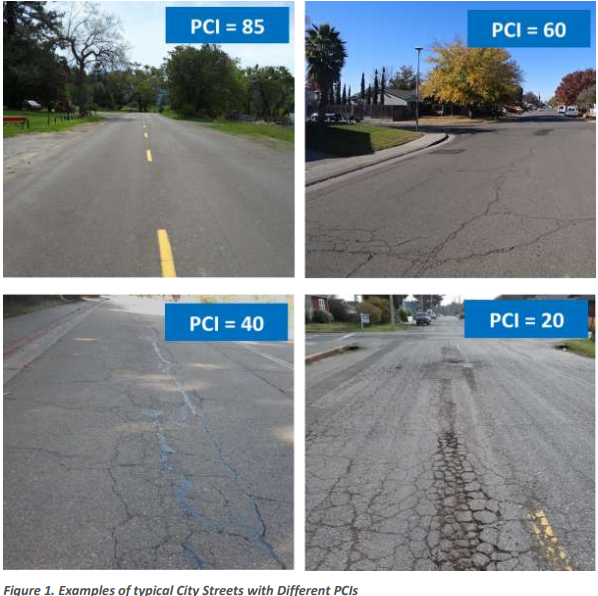
- Most of the discussion was around the pavement assessment report we received. Overall Pavement Condition Index (PCI) of the City is approximately 73. The scale is out of 100, and is divided into four general condition categories. Pavements in “Good” condition have a PCI above 70, pavements in “Fair” condition have a PCI between 50 and 69, pavements in “Poor” condition have a PCI between 25 and 49, and finally pavements in “Failed” condition have a PCI below 25. Here are examples roads with different PCI values:


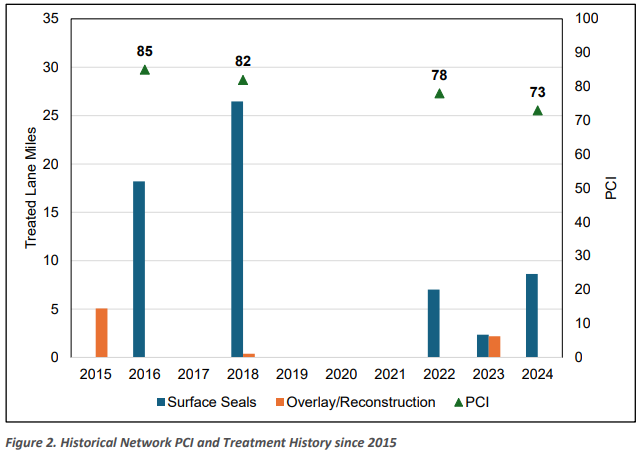
While a score of 73 is considered "good", it also reflects consistent and steady declines over the last 10 years.


The table above shows the current score of 73, with a score of 85 in 2016. This table also illustrates the work that has been done on City streets. We typically do work every two years in order to get slightly lower costs with larger scale. The work scheduled in 2020 was postponed due to COVID.

Picking the streets to work on is a bit counterintuitive. At first it may seem logical to pick the streets that are in the worst condition. However, rehabilitating these streets is also the most costly. With limited funds, the entire pool could be consumed with 1 or 2 streets, leaving the rest of the streets in the city to continue to deteriorate through normal wear and tear. As a result, it is often more cost efficient to do maintenance on a streets in better condition, as maintaining current conditions is less expensive in the long run, and more areas of the city could be improved.

The City uses a program called StreetSaver. This program is designed to maximize PCI overall in the City based on the amount of funds available. Because it costs more to rehabilitate streets in poor condition often StreetSaver will not select the streets in the worst condition for maintenance and rehabilitation work.

Given the steady decline in PCI overall, it is important to determine what level of funding is necessary to maintain the current road conditions. Each year we receive approximately $1M in our share of gas tax, and other state and local funding. We accumulate these funds and every other year pick streets to do maintenance on in order to improve the road condition and the overall PCI.

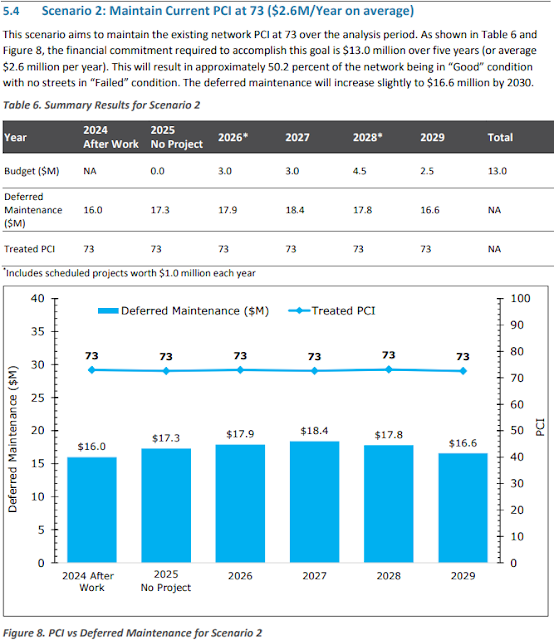
Based on analysis, in order for the City to simply maintain a PCI of 73 that it currently has overall, the City would need to spend approximately $13M over 5 years, or $2.6M/year. Our funding is approximately $1M/year.


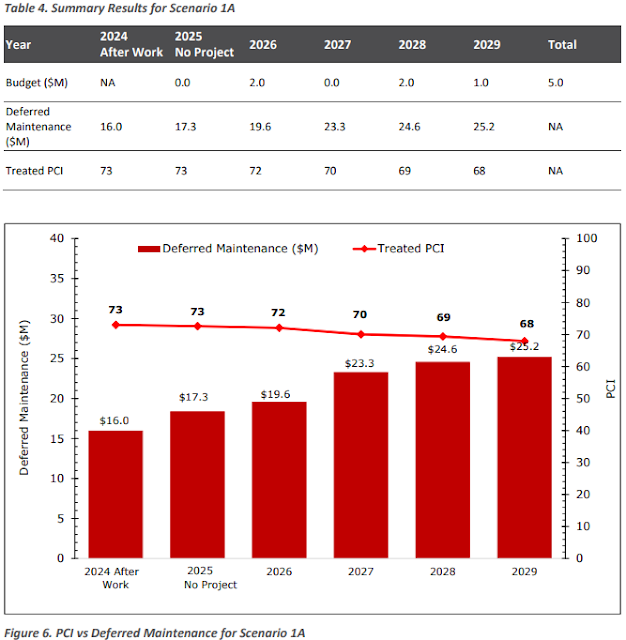
Unless the City is able to spend a significantly greater amount on street maintenance and rehabilitation, the conditions of roads in the City will continue to decline. At our current rate of spending, this is the projected outcomes on overall road conditions:


Total general fund revenues for the entire year are projected to be just under $6M. As we enter the budget planning process, we will need to begin a discussion with the community regarding what level of overall services, quality of streets, and maintenance of the City is desired, and what we are willing to pay for.

A link to the detail by street PCI for both the 2025, and 2023 years can be found here: https://docs.google.com/spreadsheets/d/1sUUWREdNL1FC1iccvXJghYzsAv5IhBd4/edit?usp=sharing&ouid=103891531140515892067&rtpof=true&sd=true

- The Oakhurst Geological Hazard Abatement District (GHAD) Board also met and adopted a resolution declaring the intent to increase the overall assessments in the District in accordance with Prop 218. Ballots will be mailed to properties in the district no later than 4/18. There will be a public hearing on 6.3.25 to determine the results of ballots received. More to come on what this means for the GHAD.

Tuesday, March 4, 2025

City Council Meeting Summary - Jeff Wan 3-4-25

City Council Correspondence: The excerpts below have been sourced from the website of council member Jeff Wan to share with the Clayton Watch Community. You can access council member Wan's website by following this link: https://www.jeffwanforclaytoncitycouncil.net

While we may not always agree with the opinions shared, we believe in facilitating a platform for respectful debates. Thank you for contributing to the ongoing conversation in the comments section. Remember to keep your comments respectful and concise.

------------------------------------------------------------

Last night the Council met to discuss one significant item:

- We authorized the recording of a noise abatement agreement for Oakhurst Golf Course. City ordinance prohibits landscaping work before 7am, however due to the nature of golf course operations Oakhurst has always had an agreement with the city that allows them to start earlier. The prior agreement had expired and the City renewed it with updated terms last night.

The new agreement has a 36 month term, and provides that no maintenance activity shall be performed prior to 5:30am. It also specifies later start times around certain areas of the course to reduce the noise impact to nearby residences. The agreement provides an avenue for complaints and a resolution process as well, and includes a provision that a survey of adjacent residences towards the end of the term of the agreement will be conducted in order to collect feedback for any future modifications.

Tuesday, February 18, 2025

City Council Meeting Summary - Jeff Wan 2-18-25

City Council Correspondence: The excerpts below have been sourced from the website of council member Jeff Wan to share with the Clayton Watch Community. You can access council member Wan's website by following this link: https://www.jeffwanforclaytoncitycouncil.net

While we may not always agree with the opinions shared, we believe in facilitating a platform for respectful debates. Thank you for contributing to the ongoing conversation in the comments section. Remember to keep your comments respectful and concise.

------------------------------------------------------------

Councilmember Wan
Last night the Council met and had one significant item on the agenda, however the meeting had extensive discussion on some other topics.

- We discussed a renewal of a noise abatement agreement with Oakhurst Country Club.  Due to the nature of golf course operations, several maintenance activities occur daily and at early hours in the day.  Things like mowing the grass and resetting tee boxes and greens take place before play begins, which is typically at sunrise.

Current City ordinances prohibit certain noise creating activities like mowing lawns prior to 7am each day.  Because time of use for the golf course starts at 7am, maintenance has always happened prior to that time.  Historically there has existed a noise abatement agreement which granted Oakhurst permission to operate certain equipment at earlier times in the day - with the focus on areas away from homes, though not entirely.

The noise abatement renewal did not change any of the existing provisions substantively.  We later determined that the wrong version of the agreement was included in the agenda packet.  In addition, there was feedback provided by residents regarding Oakhurst maintenance operations, alleging operations outside the time permitted per the noise agreement.  As such, the Council tabled this until a later date and asked our City Manager to approach Oakhurst to see if there were other provisions that could be adjusted.

- We discussed the salary schedule of the Police Chief position which is currently vacant and being filled on an interim basis.  The Council agreed to increase the salary schedule by 4% consistent with the agreement that was in place with the prior Police Chief.  When the recruitment period ends, we will discuss with the City Manager whether any additional changes need to be made to attract qualified candidates.

The Oakhurst Geological Hazard Abatement District (GHAD) Board also met and discussed a few significant items:

- We selected a new Chair (myself) and Vice Chair (Boardmember Enea)

- We received the annual engineer's report which indicated several areas where maintenance was recommended.  Without adequate maintenance, the risk of damage due to Earth movement increases.  Without additional funding however, the GHAD would need to use between 2-3 years worth of funding from the future to cover the cost.  Without additional funding, I did not think it was prudent to spend all of the remaining GHAD funds on maintenance that may not add value, and would need to be performed on a repeated basis.  Rather, I thought it was more important to take steps to increase the revenues so as to make the GHAD more solvent.

- We discussed the process for a ballot measure to increase GHAD assessments.  A notice would be sent to all residents in the GHAD, and ask them to approve a rate increase.  The amount of the increased assessment would vary based on the type of residence.  Votes are counted on a per residence basis, with a greater weight going towards those residences of higher value or at higher risk of being impacted.

The Board gave direction to pursue the rate increase, including the establishing of a reserve, and determine whether a citizen oversight committee was possible with this type of assessment.  If the voters of the GHAD approve the rate increase (towards the May/June timeframe), then the GHAD would be funded sufficiently to perform the operations it was intended to.  If the voters reject the rate increase, that would cause nearly all GHAD activities to cease.